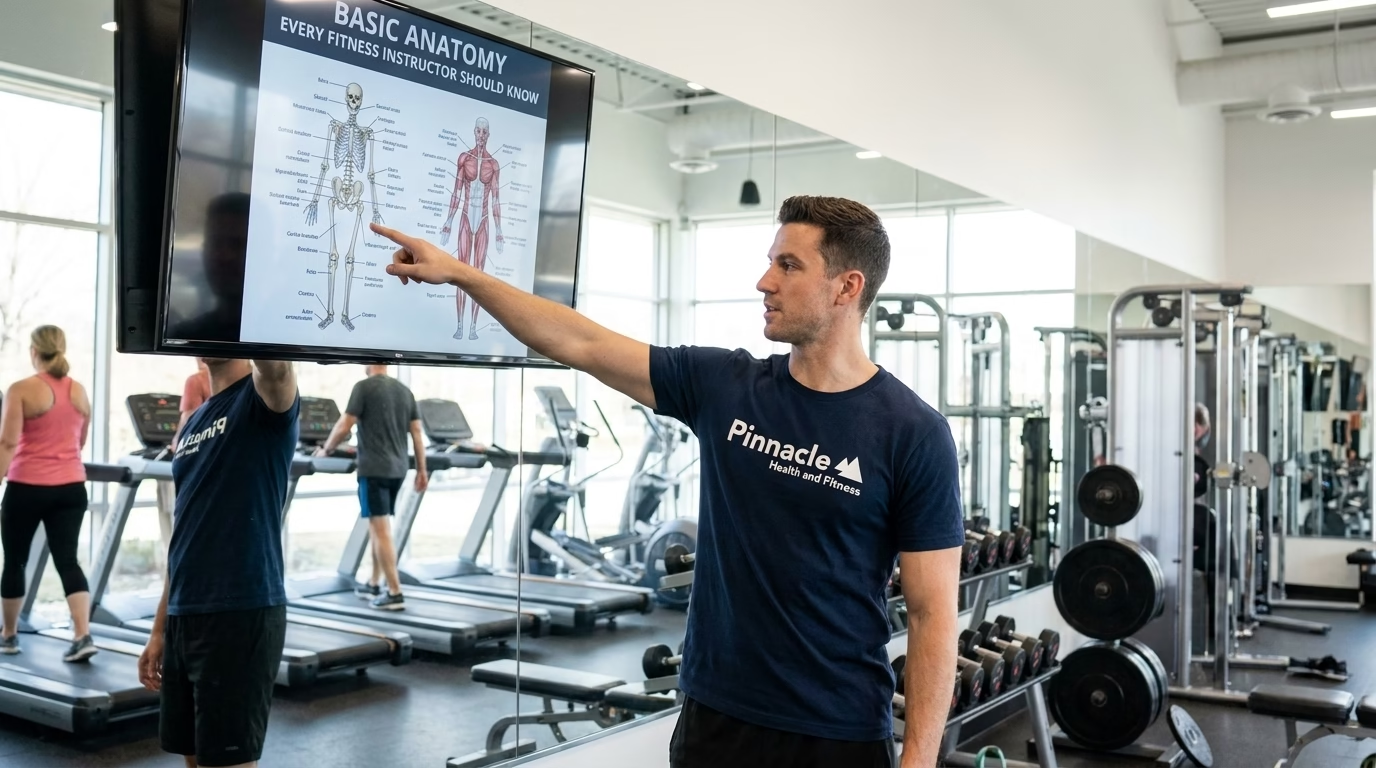
If you're serious about a career in fitness, anatomy isn't just a module you work through to tick a box — it's the language you'll use every single day on the gym floor.
Understanding how the body is built, how it moves, and how it responds to exercise is what separates a knowledgeable instructor from someone simply counting reps.
At Pinnacle Health and Fitness, anatomy sits at the heart of our qualifications. Whether you're starting out with the Level 2 Diploma in Gym Instruction, progressing to the Level 3 Diploma in Personal Training, or taking the fast-track route with our Combined Level 2 and Level 3 Diploma, you'll build a thorough understanding of the human body that directly supports your ability to design safe programmes and coach clients with confidence.
This article walks you through the key anatomical concepts every fitness instructor should know — and explains why getting this foundation right matters so much for your career.
Why Anatomy Matters for Fitness Professionals
You cannot deliver safe, effective exercise instruction without a working knowledge of anatomy. When a client performs a squat incorrectly, you need to understand which muscles are underperforming and which joints are being placed under unnecessary stress.
When someone reports discomfort during an overhead press, you need to know whether the issue is likely to stem from shoulder impingement, poor thoracic mobility, or a weakness in the rotator cuff.
This level of applied understanding isn't optional — it's what your clients expect and what industry employers look for.
Our qualifications, accredited by YMCA Awards and mapped to CIMSPA standards, ensure that every Pinnacle Health and Fitness learner graduates with anatomy knowledge that is tested, applied, and industry-ready.
The Skeletal System: Your Framework for Everything
The human skeleton does far more than provide structure. It protects vital organs, produces blood cells, stores minerals, and — crucially for fitness instructors — provides the leverage system through which all movement occurs.
Understanding the skeleton helps you to assess posture, identify movement dysfunctions, and programme exercises that are appropriate for your client's physical make-up.
Key areas to understand include:
- Axial skeleton — the skull, vertebral column, and ribcage. Understanding spinal curvatures (cervical lordosis, thoracic kyphosis, lumbar lordosis) is essential for identifying postural imbalances and selecting appropriate corrective or accessory exercises.
- Appendicular skeleton — the shoulder girdle, arms, pelvis, and legs. This is the structure through which most resistance and functional training movements are performed, making it directly relevant to everyday programme design.
- Joint classification — from hinge joints (elbow, knee) to ball-and-socket joints (hip, shoulder), understanding joint type dictates range of motion expectations and informs exercise selection.
In our blended 16-week delivery model at Pinnacle Health and Fitness, the skeletal system is introduced in your very first lesson — and it's available to try completely free. Understanding bones and joints underpins everything that follows in your training.
The Muscular System: Where Training Decisions Are Made
A sound knowledge of muscles — where they attach, what actions they perform, and how they are trained — is perhaps the single most important area of anatomy for a fitness instructor. It informs every exercise you choose, every cue you give, and every programme you design.
Major Muscle Groups
- Quadriceps (rectus femoris, vastus lateralis, vastus medialis, vastus intermedius) — responsible for knee extension; targeted in squats, leg press, and lunges.
- Hamstrings (biceps femoris, semitendinosus, semimembranosus) — responsible for knee flexion and hip extension; targeted in deadlifts, leg curls, and Romanian deadlifts.
- Gluteus maximus and medius — the primary hip extensors and abductors; critical for lower limb stability and often a focus of corrective work.
- Pectorals (pectoralis major and minor) — the primary chest muscles; trained through pushing movements such as the bench press and press-up.
- Latissimus dorsi — the large back muscle responsible for shoulder adduction and extension; targeted through rows and pull-down movements.
- Core musculature (transversus abdominis, internal and external obliques, erector spinae) — essential for spinal stability, force transfer, and injury prevention across virtually every exercise.
Muscle Roles in Exercise
As a fitness instructor, you also need to understand how muscles work together during exercise. Muscles can act as:
- Agonists (prime movers) — the primary muscle producing the movement.
- Antagonists — the opposing muscle that relaxes to allow the movement to occur.
- Synergists — muscles that assist the prime mover.
- Stabilisers — muscles that maintain postural alignment and joint integrity during movement.
Understanding these roles allows you to coach more precisely, identify compensation patterns, and programme for balanced muscular development — a skill set that becomes increasingly important as you progress into personal training and specialist client work.
Muscle Fibre Types and Training Application
Not all muscle fibres are the same. Understanding fibre type composition helps explain why different people respond differently to training stimuli — and informs how we design programmes for different goals.
- Type I (slow-twitch) fibres — fatigue-resistant and highly aerobic; dominant in endurance-based activities such as long-distance running and cycling.
- Type IIa (fast-twitch oxidative) fibres — a hybrid fibre type capable of producing moderate force over moderate durations; respond well to circuit training and hypertrophy work.
- Type IIx (fast-twitch glycolytic) fibres — produce high force rapidly but fatigue quickly; most relevant to heavy resistance training and power-based activities.
This knowledge becomes particularly relevant at Level 3, where programme design for specific client outcomes — fat loss, muscle gain, athletic performance — requires a deeper understanding of the physiological responses to different training stimuli.
Planes of Motion and Anatomical Terminology
Fitness instructors need a shared vocabulary — not only to communicate professionally with colleagues and employers, but to accurately describe movement and explain exercise technique to clients.
- Sagittal plane — divides the body into left and right; movements include flexion and extension (e.g. squats, bicep curls).
- Frontal plane — divides the body into front and back; movements include abduction and adduction (e.g. lateral raises, side lunges).
- Transverse plane — divides the body into upper and lower; movements include rotation (e.g. cable rotations, medicine ball throws).
Alongside planes of motion, instructors should be confident with terms such as proximal/distal, anterior/posterior, medial/lateral, superior/inferior, and movements including pronation, supination, circumduction, and dorsiflexion. This terminology forms the foundation of professional communication in gym, clinical, and sports settings alike.
The Cardiovascular and Respiratory Systems
A fitness instructor's anatomical knowledge isn't limited to the musculoskeletal system. Understanding how the heart, blood vessels, and lungs respond to exercise is equally important — both for safe exercise delivery and for educating clients about the health benefits of training.
- Cardiac output — heart rate multiplied by stroke volume; understanding how cardiac output increases during exercise allows instructors to monitor intensity appropriately.
- Blood pressure — an understanding of systolic and diastolic pressure is essential when working with clients who have hypertension or cardiovascular risk factors.
- Oxygen delivery — aerobic and anaerobic energy systems underpin exercise intensity prescription and are closely linked to both fibre type knowledge and programme design.
At Pinnacle Health and Fitness, we build cardiovascular and respiratory anatomy into our applied exercise science content across both Level 2 and Level 3, ensuring learners understand the physiological basis of the sessions they are delivering.
How Pinnacle Health and Fitness Teaches Anatomy in Practice
Understanding anatomy in a textbook and being able to apply it on the gym floor are two different things. That's why our blended delivery model combines online theory modules with live tutor-led webinars and hands-on practical workshops — so anatomy doesn't stay abstract for long.
Most learners complete their qualification in around 16 weeks, though we understand every learner is different. Our delivery is flexible and adaptable to suit your personal schedule, experience, and pace. Whether you're working full-time, fitting study around family commitments, or accelerating through the material, we structure our support accordingly.
Our YMCA Awards accreditation means every anatomical concept you study is mapped to nationally recognised standards and CIMSPA professional benchmarks. This isn't a tick-box exercise — it's the curriculum standard that fitness employers across the UK expect.
The career pathway we've built at Pinnacle Health and Fitness follows a clear progression:
Anatomy is the foundation of that entire journey. It starts in your very first lesson and becomes progressively more applied as you move from gym instruction through to personal training.
Looking further ahead, we're expanding our curriculum in 2026 to include Strength and Conditioning and Applied Nutrition pathways — further positioning Pinnacle Health and Fitness as a long-term development provider for fitness professionals at every stage of their career.
Ready to Build Your Anatomical Foundation?
If you're ready to learn anatomy the right way — embedded in practical, industry-recognised training — we'd love to hear from you. Explore our qualification pathways at pinnaclehealthfitness.co.uk and take your first lesson for free. Your career in fitness starts with understanding the body — and we're here to guide you every step of the way.
Frequently Asked Questions
No prior anatomy knowledge is required to begin the Level 2 Diploma in Gym Instruction at Pinnacle Health and Fitness. Our programme introduces anatomy progressively, starting with the skeletal system in Lesson 1. You'll build your knowledge systematically, supported by our tutors through online modules, live webinars, and practical workshops.
Anatomy and physiology are assessed through a combination of open book question sheets, portfolio evidence, and practical observation. Our YMCA Awards accredited assessments are designed to confirm that you can apply your knowledge in real exercise environments, not just recall it on a page.
Even at Level 2, anatomy underpins every interaction you have on the gym floor. Understanding how muscles, joints, and the cardiovascular system work allows you to offer accurate exercise guidance, spot poor form, and ensure client safety. Employers across the fitness industry expect this foundation as standard.
Yes. At Level 3, anatomy and physiology content deepens to include exercise physiology, adaptations to training, energy systems, and the anatomical basis of specialist programme design. This is why the Level 2 Diploma in Gym Instruction is the recommended starting point — it gives you the anatomical grounding that Level 3 builds on directly.
Yes. All anatomy content delivered through Pinnacle Health and Fitness is accredited by YMCA Awards and mapped to CIMSPA professional standards — the benchmarks that define competent fitness practice in the UK. This ensures that what you learn with us is both nationally recognised and directly applicable in the workplace.